
Concho County Release Records
Concho County released inmates do not leave a county-run jail because Texas Commission on Jail Standards reports identify Concho as a county with no jail. An arrest can still occur. The Sheriff creates the arrest and transport trail, an outside receiving jail creates the booking and book-out trail, and a Concho court creates the legal trail. Those records must be joined to show what happened. A person disappearing from a host jail roster is only a clue. The person may have bonded out, finished a term, entered probation, transferred to TDCJ, or moved under another agency's hold.
A release means one custodian ended physical control. It does not always mean the person returned to the community. Transfers to another county, TDCJ, the U.S. Marshals Service, or ICE are custody changes. Parole and mandatory supervision also end prison confinement while supervision continues. A full discharge is different because the sentence and supervision have ended. Keeping those terms separate prevents a release date from being read as proof that all legal restraint ended.
- Book-out
- The receiving jail's record of the time its custody ended.
- Transfer
- Movement to another custodian, not community release.
- Parole
- Supervised release from a state prison sentence after Board approval.
- Discharge
- The end of the sentence and any linked supervision.
Concho County Release Types
The release authority explains why a jail acted. It may appear as a code on the host jail record and as a signed order in the court file. The physical book-out time can follow the court event, so both records matter.
| Release type | Meaning | Next record |
|---|---|---|
| Bond or personal bond | The jail acted on valid release authority; the charge remains pending unless the court says otherwise. | Bond order, docket, and book-out entry |
| Time served or completion | The credited custodial term ended, subject to any other hold. | Judgment, credit calculation, and release log |
| Probation | A court placed the person on community supervision. | Court order and Concho Valley CSCD |
| Parole or mandatory supervision | State confinement ended while TDCJ supervision began. | TDCJ status and Parole Division record |
| Transfer or detainer pickup | Another agency accepted custody. | Transport record and destination agency file |
| Dismissal or acquittal | A case ended favorably, though another case or hold may remain. | Clerk disposition plus physical release record |
Death in custody is not an ordinary release and must never be labeled as one. Likewise, a TDCJ projected date, parole vote, or court order is not the actual moment that a door opened.
Fields in Concho Release Records
A complete Concho County release record is often a packet from several custodians. Ask for the host jail's booking-out record and Concho Sheriff's arrest and transport material. Then compare both with the court case. The following fields establish identity, timing, authority, and destination.
| Field | What it establishes |
|---|---|
| Name, aliases, DOB, local ID | Which person the record concerns and whether similar names are a false match |
| Booking number and arrest agency | The exact custody event and its link to the Concho arrest |
| Book-in and book-out date and time | The host jail's physical custody window |
| Charge and bond fields | The listed case basis and any release security |
| Release authority and type | Why that custodian ended custody |
| Destination or transfer agency | Whether the person entered the community or another custody system |
| Property inventory and receipt | What was held, returned, or sent onward |
A photograph can tie a person to a booking, but it cannot prove release. Court records can explain bond, dismissal, sentence, or supervision, yet a signed order alone does not establish the minute of departure. Label every date as ordered, projected, scheduled, or actual.
Request Concho County Release Records
Concho County requires a written public-information request to the department that actually holds the record. The wrong office has no duty to forward it. Because the county has no jail, parallel requests are often needed. Use the county's public-information instructions and its request form.
- Call Sheriff dispatch with the full name, date of birth, approximate arrest date, and arresting agency. Ask which facility accepted custody.
- Send the Sheriff a written request for existing arrest, transport, destination, property, and locally created photograph records.
- Send the receiving jail a separate request for booking-in, booking-out, release authority, release reason, bond, destination, and photo fields.
- Ask the combined County and District Clerk for the cause file, bond order, judgment, dismissal, sentence, supervision, and discharge documents.
- Request electronic public portions and an itemized estimate before costs exceed a stated limit. Ask the office to cite the basis for any withholding.
152 N. Roberts, PO Box 67
Paint Rock, TX 76866
325-732-4312
No local flat fee for these records was found. The Texas Attorney General explains that an office may release records, seek clarification or cost action, or request a ruling by the tenth business day. That point is not a universal production deadline.
Property After Concho County Release
Texas Local Schedule PS treats prisoner property inventories and receipts as separate records. Their minimum retention runs through release or transfer plus two years. A Concho arrest can split the property trail. The Sheriff may record items taken at arrest, while the outside jail may document storage, return, or transfer.
Request both sets promptly and ask which agency physically returned or moved the property. Do not travel to Paint Rock expecting a county jail property window. The actual receiving jail controls its exit, pickup, and transfer practice, and the research identifies no universal local release door or transport arrangement.
Texas Law on Concho Releases
The Texas Public Information Act, Government Code Chapter 552, covers government-held public information subject to exceptions. Release logs, booking-out sheets, transfer orders, and government photos can fall within it. Section 552.108 may protect some law-enforcement material, while subsection (c) preserves basic arrest information. Ask for separable public parts rather than assuming the whole file is open or closed.
Local Schedule PS sets a release-or-transfer-plus-two-years minimum for core incarceration records. It does not promise that a web page remains online. A pending request or legal hold can extend retention. Court files and arrest reports can last longer than a short-lived roster.
Expunction After Concho County Release
Texas Code of Criminal Procedure Chapter 55A now includes a direct release-stage rule. Article 55A.451 requires a written explanation of expunction rights and a copy of the chapter when a person is released or discharged after arrest. This notice does not prove eligibility. The result depends on the case, charge, disposition, time limits, and other statutory conditions.
A valid expunction order can require covered identifying material to be returned, destroyed, or restricted. Nondisclosure under Government Code Chapter 411 is different and does not erase every record. Either remedy can explain why an older release entry or photograph later disappears from public view. The Texas court forms and the Concho clerk are the proper starting points for nondisclosure records.
Find Concho County Released Inmates
Start with custody class, not one broad name search. County, state, federal, and immigration systems cover different people. Exact identifiers reduce false matches.
- For a Concho arrest, call the Sheriff or 24/7 Eden dispatch and identify the outside receiving jail.
- Search that jail's official roster or release view. If the record is gone, request its booking-out and transfer file.
- For a Texas prison commitment, use the TDCJ offender search and compare the TDCJ or SID number, date of birth, offense, and county.
- Search the Concho court portal for bond, disposition, sentence, probation, revocation, or discharge.
- Use IVSS only for status and alerts. For Eden or other federal custody, choose BOP, ICE, or USMS based on the legal custodian.
- When an online result fails, request records from each agency that created part of the custody trail.
The Concho County 24-hour release route explains the same-day fallback when no county feed exists. It is useful for recent events, while the process above follows one named person across time.
Concho Release Dispatch Route
The Sheriff has two law-enforcement touchpoints. The Paint Rock office keeps split weekday hours, while Eden Law Enforcement Center dispatch operates around the clock at 325-869-4941 or 325-869-2222. Dispatch can identify the receiving facility for a person-specific arrest.
That answer is a routing fact, not a release certificate. Write down the facility name, transfer date if supplied, and any booking number. Then ask the receiving jail for its own record. No reliable source establishes one standing host jail for all Concho arrests, so naming Runnels, Tom Green, or another county without confirmation would risk sending the search to the wrong agency.
Bond and Concho Release Timing
Concho County publishes no official countywide bond schedule, bail-bond-board page, pretrial-services office, or online bond-out directions. For a named case, the Justice of the Peace or assigned court can establish the bond order. The actual receiving jail establishes when physical release occurred.
Those timestamps may differ. Posting or ordering bond begins release processing, but another hold, identity check, transport step, or jail workflow can delay the exit. A court entry should therefore be paired with the book-out record rather than treated as the final release time.
Concho Release Court Trail
Concho has a combined County and District Clerk. The official clerk page says digitally available records are placed online and updated nightly at midnight. Search the LGS Online Records Search for the cause number, bond events, disposition, judgment, sentence, probation, revocation, and discharge.
The midnight refresh is not a release feed and does not mean someone left a jail at midnight. It is a durable legal trail after short-term custody data disappears. Sealed, expunged, nondigitized, or restricted material may be absent. Request a copy from the clerk when the portal shows only an index.
The official Concho clerk page shows the local access route.
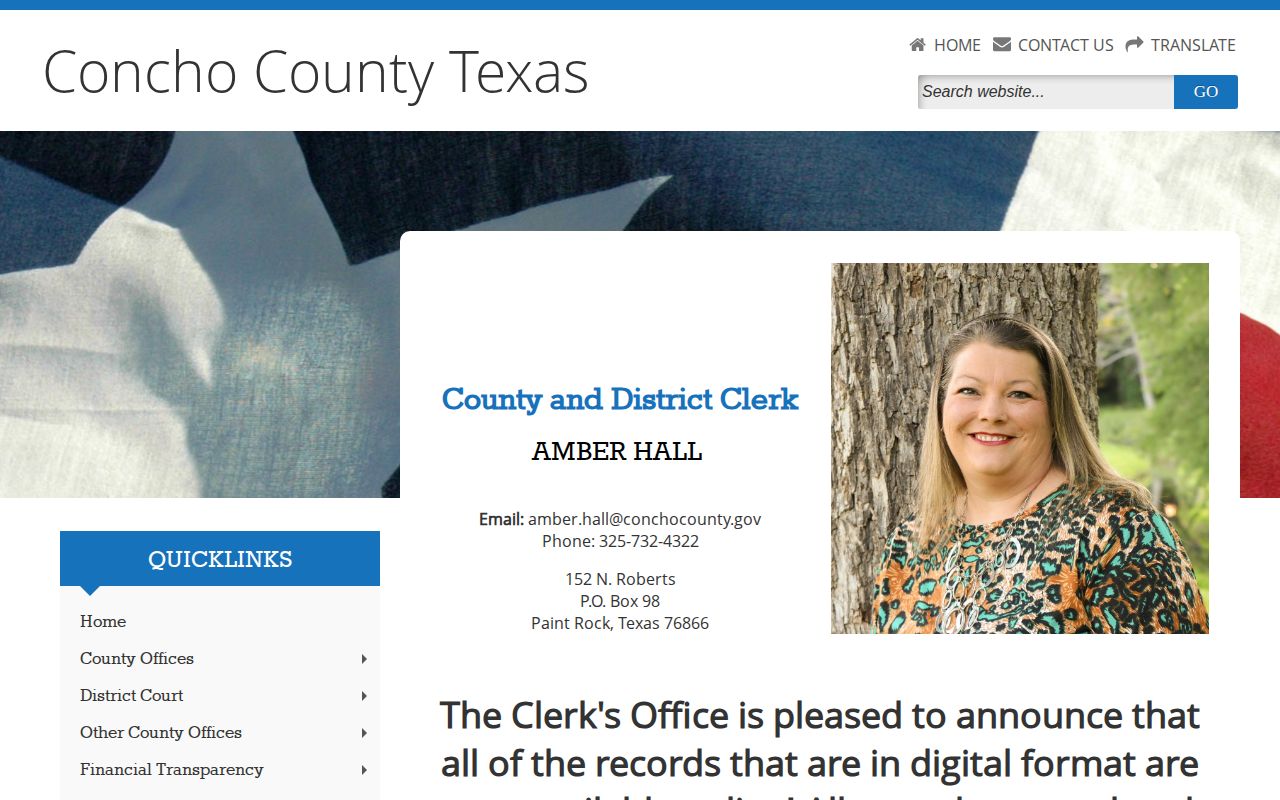
The clerk source helps explain the court event, while the receiving jail record proves the physical end of custody.
TDCJ Concho Release Search
The Texas Department of Criminal Justice offender search applies to a person committed to Texas state prison or released to parole or mandatory supervision. It is not the first tool for a short stay in an outside county jail. Search by name and narrow with gender and race, or use a seven-digit TDCJ number or SID.
| Search or result field | How to use it |
|---|---|
| First and last name | Start broad, then compare identifiers |
| TDCJ number or SID | Use the unique state identifier when known |
| DOB, offense, county, court | Reject similar-name matches |
| Projected Release Date | Treat as a calculation, not actual release |
| Scheduled Release | Processing has advanced, but the date can change |
| Parole review and status | Distinguish review, approval, release, and discharge |
TDCJ states that search data is at least 24 hours old and updates on working days. If a fully discharged person does not appear, request incarceration history or release information through the TDCJ email route. The state page defines projected release and lists the identifiers needed for a no-charge general information request.
Concho Release Alerts and Federal Records
Texas replaced legacy VINE with IVSS-Counties for participating county systems and TDCJ IVSS for state custody, parole, and mandatory supervision. Concho Sheriff's old VINELink referral remains a local signpost, but the current portals should be used. An alert is a prompt to verify with the custodian, not a certified release record.
Eden Detention Center is a separate federal and immigration branch. Use the BOP Inmate Locator only for a BOP record. A result can show a release date or “Not in BOP Custody,” but that does not rule out ICE, USMS, local, or state custody. ICE's locator covers current detention and some recent releases within its stated scope. USMS has no comparable public historic locator, so facility confirmation, the federal docket, and USMS FOIA are the fallback.
The BOP locator image shows the official federal route used when the person was actually in BOP custody.
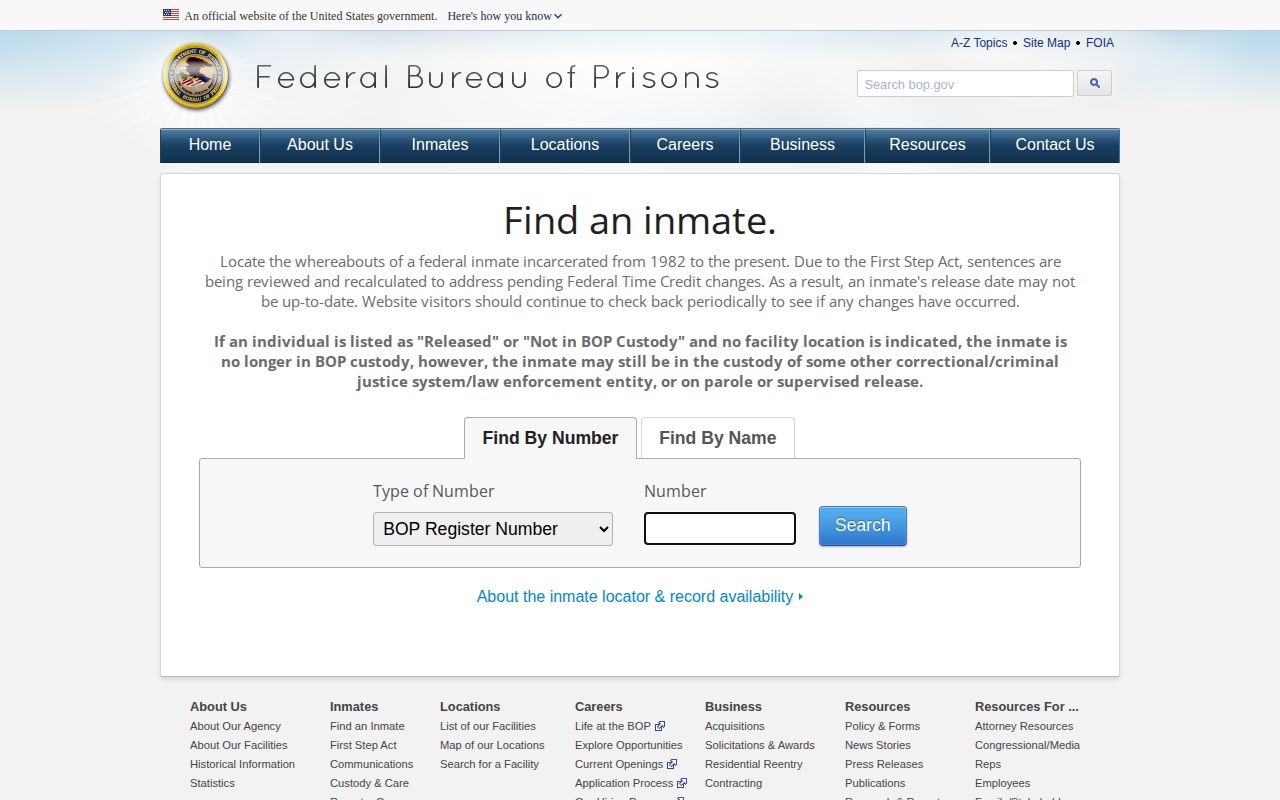
A BOP status confirms only the federal prison branch, not community release from every possible custodian.
Concho Released Versus In Custody
Choose the source that can answer the exact custody question. A live roster is mainly a current-custody tool, while a release log is historical proof from that jail.
| Source | Best evidence | Main limit |
|---|---|---|
| Receiving jail roster | Current custody at that jail | Absence does not prove release |
| Booking-out record | Actual exit time and reason from that jail | Exit may be transfer |
| Concho court file | Bond, disposition, sentence, supervision | Does not prove the physical exit minute |
| TDCJ record | State prison status, dates, parole | Not for a short county-jail stay |
| BOP or ICE locator | Status within that federal system | Does not exclude other custody |
For active Chapter 62 duties, the Texas DPS registry may corroborate post-release identity and presence. It is not a general release list, and absence proves neither release nor confinement.
Concho County Release Facilities
The Concho County law-enforcement operation is the arrest and routing branch, not an operating jail. Sheriff dispatch identifies the outside jail, which then owns the booking-out record. The Eden Detention Center is a private federal contract facility with a current USMS customer base and possible immigration custody. It is not the county's booking destination by default.
Eden's history explains stale directory labels. Its BOP contract ended and the facility closed in 2017, then it reopened under a USMS contract in 2019. Current custodian-specific sources are safer than an old “BOP prison” label. In both facility branches, release must be stated as exit from the named custodian until the destination is confirmed.
Public Record Search
Sponsored Results