
Concho County Parole vs Probation
Parole and probation both place a person in the community under rules, but they arise from different decisions and leave different records. The Texas Board of Pardons and Paroles decides parole matters. The TDCJ Parole Division supervises people released on parole or mandatory supervision. A Concho court orders probation, while the regional Concho Valley Community Supervision and Corrections Department carries out local supervision.
| Point | Parole | Probation |
|---|---|---|
| Starting event | Release from a TDCJ sentence after Board action or mandatory-supervision processing | A sentence or court order placing the person on community supervision |
| Decision maker | Texas Board of Pardons and Paroles | The court handling the Concho County case |
| Supervising system | TDCJ Parole Division | Concho Valley CSCD |
| Best record | TDCJ offender and parole-review information | Judgment, docket, and CSCD confirmation |
| End of supervision | Parole or mandatory-supervision discharge | Court or CSCD discharge after the ordered term |
Verify Concho County Post-Release Supervision
A reliable check starts with identity and the underlying case. A name alone can match more than one person, and a release record only proves exit from a named custodian. Use a TDCJ or SID number for state parole when available. For probation, use the Concho cause number and the court disposition.
- Determine whether the person served a TDCJ sentence or received community supervision in a Concho court.
- For parole, open the TDCJ Inmate Search and compare name, number, county, offense, and parole-review information.
- For a Board decision, use the BPP result routes or call 844-512-0461 with the TDCJ or SID number and date of birth.
- For probation, check the combined County and District Clerk record, then call Concho Valley CSCD with the cause number.
- Ask the responsible office whether supervision is active, discharged, transferred, or subject to a warrant. Do not infer status from a missing web result.
Note: Eligibility, a favorable vote, scheduled release, physical release, active supervision, and final discharge are separate events in Texas.
Concho Valley CSCD Office Detail
Concho County directs probation questions to the regional Concho Valley CSCD rather than a county-only probation desk. The official county probation page lists offices in San Angelo and Ballinger. Call with the full name and cause number to learn which unit handles the case. Do not send parole inquiries to these offices because TDCJ controls that branch.
Regional probation contacts
San Angelo: 3036 N. Bryant Blvd., San Angelo, TX 76903
Phone: 325-659-6544
Runnels office: 608 Strong Ave., Ballinger, TX 76821
Phone: 325-365-3452
Source: Concho County Probation
Concho Supervision Conditions and Warrants
Conditions come from the controlling order. They may include reporting, residence approval, travel limits, treatment, testing, fees, or other case-specific terms. The online record does not replace that order. A violation allegation also does not equal a final revocation. The supervising officer, warrant unit, court, or Board determines the next step under the applicable process.
TDCJ explains that parole warrants and absconder issues belong to the Parole Division. County probation violations return to the court and CSCD path. If safety or custody status matters, use official channels and do not confront the person. Texas IVSS can provide state custody or supervision event alerts, but an alert is not a certified warrant check.
How Concho County Supervision Ends
Supervision ends through an official discharge, not merely because reporting appears to stop. For probation, seek the discharge order or docket entry from the combined County and District Clerk and confirm the result with CSCD. The clerk states that digitally available records are updated nightly at midnight, but that update is a court-index cadence, not a live supervision feed. Nondigitized, sealed, or expunged material may not appear.
For parole or mandatory supervision, confirm the discharge through TDCJ Classification and Records or a formal TDCJ records request. The Concho County released-inmate search and records guide explains how court, arrest, transport, and custodian records fit together. A discharge from parole is distinct from release from prison and from completion of every separate case.
Texas Parole Review for Concho Cases
Texas does not conduct formal public offender hearings for ordinary parole or mandatory-release consideration. BPP reviews a file and panel members vote. TDCJ identifies a person about six months before initial eligibility and about four months before a later review. An Institutional Parole Officer prepares a summary, and three panel members vote in sequence until two matching votes decide the matter.
Decision codes require care. FI variants call for further investigation or release after stated steps. NR sets a future review, SA means serve all, and DMS denies mandatory supervision with another review date. A favorable result can still require program completion, an approved plan, a certificate, calculation audit, and scheduling. After approval, Review and Release Processing at 512-406-5202 can address processing status.
The official BPP review process is pictured below. It shows why a vote date should not be reported as the day someone left custody.
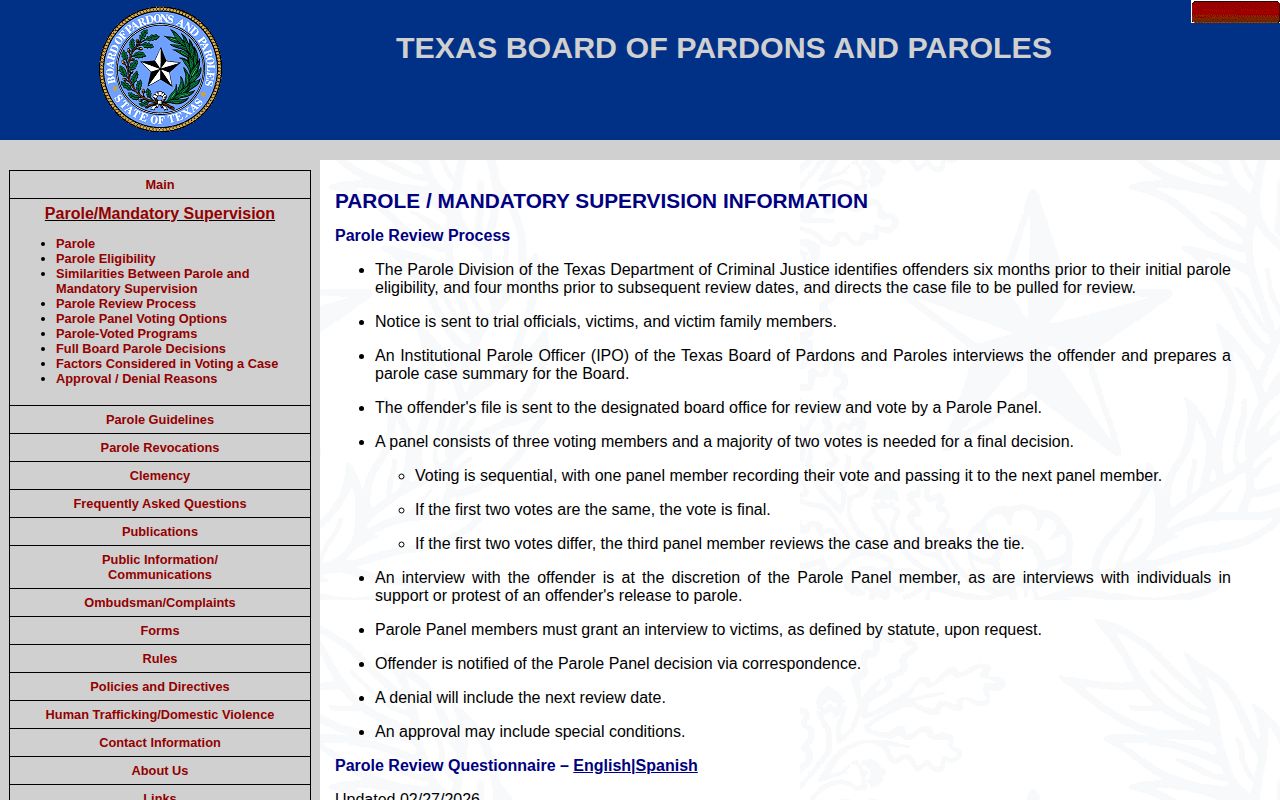
The state process supplies review context, while a physical release still needs confirmation from TDCJ or the responsible custodian.
Concho Release Property Records
Property records can help reconstruct the handoff at release. Texas Local Schedule PS separately identifies prisoner property inventories and receipts and keeps them for at least release or transfer plus two years. Because Concho County has no operating jail, the record may be split. The Sheriff may hold the arrest inventory and transport record, while the outside receiving jail may hold the final property receipt.
Request both sets promptly. Identify the person, arrest date, and receiving facility, then ask which agency physically returned or transferred the property. A property receipt can support the event timeline, but it is not proof that supervision ended or that the person entered the community.
Concho Supervision Record Boundaries
Three custody branches can touch a Concho County case, and each leaves a different post-release trail. A person who leaves an outside county jail may have no supervision, may begin court-ordered probation, or may transfer to another custodian. The receiving jail's book-out record answers only whether that jail ended custody. It does not show whether Concho Valley CSCD opened a probation file.
A TDCJ release can lead to parole, mandatory supervision, or full discharge. TDCJ Inmate Search, the Parole Division, BPP result channels, and Classification and Records cover that branch. A federal exit from Eden Detention Center belongs to BOP, ICE, or USMS according to legal custody. Federal supervised release is court based and is not Texas parole.
Start with the judgment or release authority, then contact the named supervising system. If records conflict, preserve the exact status, date, agency, and identifier shown by each source. A live-custody absence cannot settle a supervision question. Neither can a court disposition prove the minute of physical release. Matching the record to the agency prevents the common error of calling every form of community oversight parole.
Proof of Concho Supervision Status
Keep the strongest record for the question being asked. A judgment can establish that a court ordered probation, but the regional CSCD should confirm the current reporting unit and discharge status. A BPP vote can establish the panel outcome, but TDCJ should confirm whether release processing finished and whether parole remains active. When the current status matters, record the date and office of confirmation because web data and case events can change.
For a certified or durable record, ask the responsible clerk or agency for an existing document rather than an explanation created for the request. Include enough identifiers to avoid a namesake match. If the response shows a transfer, follow the new office instead of treating the old office's lack of a file as discharge.