
Concho Projected vs Actual Release
TDCJ uses Projected Release Date as a calculated field. Offense date and offense type affect it. For an eligible offense before September 1, 1996, the older mandatory-supervision framework can make that date the release point if parole does not occur. For an offense on or after that date, mandatory supervision is discretionary. If the Board does not approve it or the person is ineligible, TDCJ describes the projected date as the discharge date.
A scheduled release date and location appear later in the process. After a favorable decision and required plan steps, Classification and Records receives a certificate, audits the calculation, and may post a scheduled date and unit. Neither projected nor scheduled means the person has walked out.
A pretrial person has no TDCJ projected date. The relevant records are bond orders, court actions, the outside jail record, and any transfer or hold.
Find a Concho County Projected Date
Begin with the custody branch. Concho County law enforcement transports detainees to an outside receiving jail, and research did not establish one permanent host. Eden Detention Center is a federal contract facility, not the county jail. A wrong branch can produce a plausible but irrelevant date.
- Call Concho Sheriff or 24-hour Eden dispatch with the full name, date of birth, arrest date, and arresting agency. Ask which facility accepted custody.
- If TDCJ holds the person, use the TDCJ offender search. Compare identifiers, offense, county, location, projected release date, and parole-review information.
- If an outside county jail holds the person, request its sentence calculation or book-out record. Ask how it applies jail credit and local commutation.
- Use the Concho combined clerk and court record for the judgment, sentence, credit, bond, and later orders. The local online index refreshes nightly at midnight.
- If custody is federal or immigration based at Eden, use BOP, ICE, or USMS routes according to the legal custodian.
- After the anticipated date, obtain an actual booking-out or discharge record.
The Concho County release search gives the full records chain for a named person who has already left custody.
Texas Good Time for Concho Sentences
Texas Government Code Chapter 498 governs TDCJ good-conduct time. TDCJ awards it by classification and qualifying behavior, work, and program rules. Misconduct can forfeit credit. Section 498.003 says good time applies to parole or mandatory-supervision eligibility and does not otherwise reduce the sentence itself.
Texas does not impose a blanket rule that every prisoner must serve 85 percent. Under Government Code §508.145, the usual subsection (f) calculation generally reaches parole eligibility when calendar time plus good-conduct time equals one-fourth of the sentence or 15 years, whichever is less. Subsection (d) generally requires actual calendar time of half the sentence or 30 years, whichever is less, for aggravated and other listed cases, with minimums and exceptions. Good time does not advance that calendar threshold.
Special rules apply to capital, life, continuous-trafficking or abuse, and other categories. Eligibility only opens review. It does not compel approval, create a scheduled date, or prove release.
Why Concho Release Dates Change
A date is the output of facts and decisions that may change. The label and source matter as much as the number shown.
| Factor | Possible effect |
|---|---|
| Classification or misconduct | Changes the earning, forfeiture, or possible restoration of good-conduct time. |
| New or corrected sentence | Changes the legal calculation after a court order or records audit. |
| Consecutive cases | Moves the controlling date as sentences are combined under applicable rules. |
| Board action | Approval, denial, or later review changes parole or mandatory-supervision processing. |
| Program or residence plan | Can delay scheduling after a favorable decision. |
| Detainer or hold | May send the person to another agency rather than the community. |
| Certificate and audit | Classification and Records checks the calculation before scheduling. |
Note: TDCJ search information is at least 24 hours old and updates on working days, so recent changes may not appear.
Confirm a Concho County Release
Use the source that controlled custody. For a TDCJ case, Classification and Records handles time, transfer, and release questions at 936-437-6231 or classify@tdcj.texas.gov. Review and Release Processing handles status after a favorable Board vote at 512-406-5202. A formal TDCJ public-information request can seek actual release or discharge documentation.
For the outside county jail, request the book-out time, release authority, release type, and destination. Ask whether the timestamp marks data entry or physical departure. For Eden, first establish whether BOP, ICE, or USMS had legal custody. A facility exit may be a transfer.
Texas IVSS alerts are useful prompts. The VINE Inmate Check guide explains the current IVSS-Counties and TDCJ IVSS split. An alert still needs verification with the custodian.
TDCJ Certificate and Audit Timing
Official ombudsman guidance separates a favorable parole decision from scheduling. Classification and Records must receive the certificate and audit the calculation. The reported audit window is roughly 14 to 21 business days after the certificate, but that is guidance rather than a promise for one case. Required programming and an approved residence can also affect processing.
The safest timeline keeps every milestone: eligibility date, review date, vote code, certificate receipt, audit, scheduled date and unit, then actual release. Do not collapse them into one event. Call BPP status at 844-512-0461 before approval, and Review and Release Processing after a favorable decision.
The TDCJ projected-date definition is shown below.
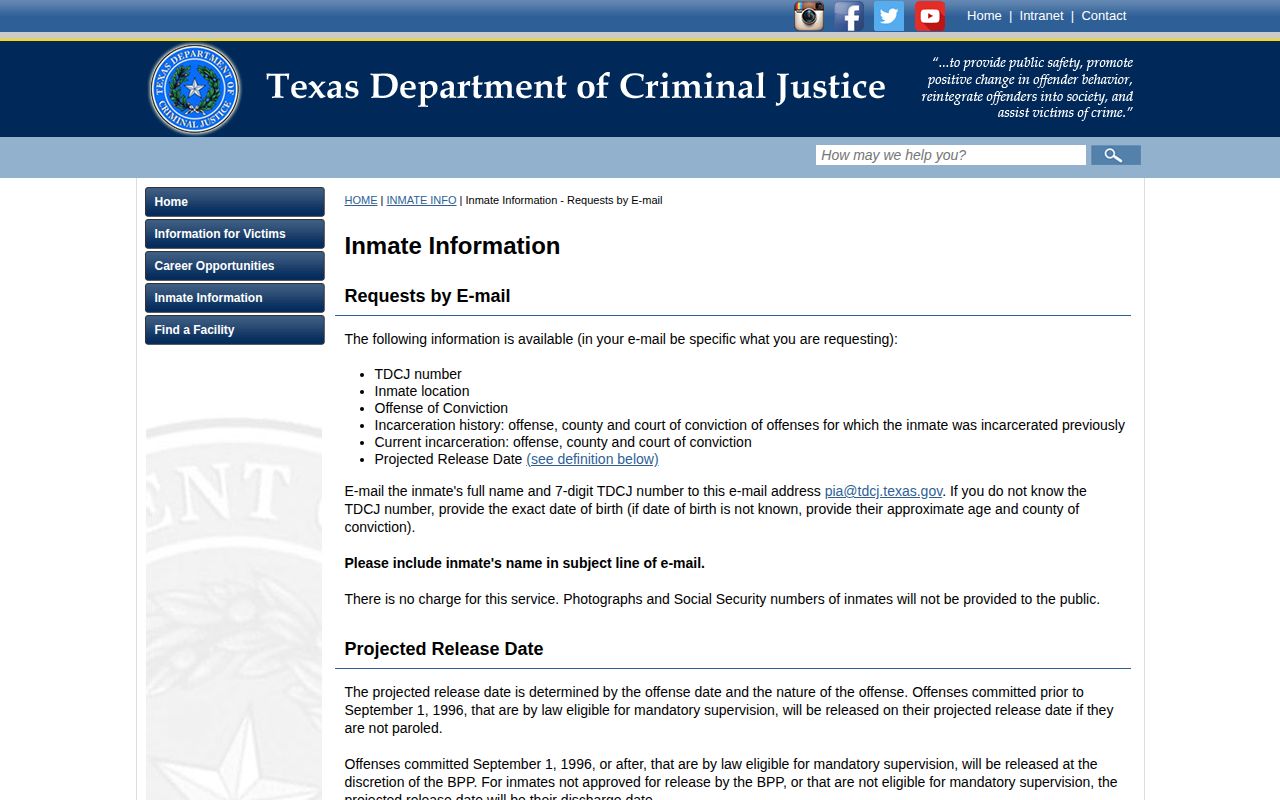
The official wording helps distinguish a calculated field from an audited scheduled date and a completed release.
Outside-Jail Credit for Concho Cases
County-jail sentences use a different rule from TDCJ calculations. Texas Code of Criminal Procedure Article 42.032 permits the sheriff in charge of a county jail to grant commutation for good conduct, industry, and obedience. The deduction may not exceed one day for each day actually served when no misconduct charge is sustained.
Concho has no jail, so a builder cannot assume how an unnamed outside sheriff applies credit. Identify the actual jail, obtain the sentencing papers and jail calculation, and ask the custodian to explain the existing record. The Concho court establishes the sentence and credit ordered by the judge, while the receiving sheriff controls its own jail record. A projected calculation from sentence length alone would omit both roles.
Concho Mandatory-Supervision Date Limits
Mandatory supervision is not an automatic arithmetic result for every TDCJ prisoner. Government Code §§508.147 through 508.149 govern this route. Section 508.149 lists excluded offenses and permits a panel to deny release when accrued good time does not accurately reflect rehabilitation potential and release would endanger the public. A denial may set another review date.
That structure explains why similar sentence lengths can produce different projected outcomes. Offense, offense date, eligibility category, good-time record, and Board action all matter. A DMS vote code means denial of mandatory supervision and includes a later review. It does not erase the sentence calculation. A projected discharge date also does not promise that no hold or new court order will intervene.
Keep parole eligibility, mandatory-supervision eligibility, Board review, projected discharge, and actual release in separate fields. When a Concho court case led to TDCJ, the court record supplies the sentence while TDCJ supplies the current calculation. Only official staff can apply all case-specific rules. Do not calculate a personal date from the sentence alone.
Concho Court and Custodian Dates
The Concho County court record and the custodian record answer different parts of the timeline. The combined County and District Clerk can supply the cause number, judgment, sentence, credit ordered, later modification, bond action, revocation, and discharge. Its digitally available records refresh nightly at midnight. That cadence makes the court index useful after short-lived custody data disappears, but it is not a midnight jail-release list.
The outside receiving jail owns the physical custody entries. Ask for book-in and book-out timestamps, release authority and type, destination or transfer agency, and the booking number. A signed bond order can precede actual departure because jail staff must receive and process the authority. A book-out can also lead to TDCJ, ICE, USMS, another county, or another secure setting.
Concho Sheriff may hold the arrest time, property inventory, transport record, receiving-facility name, and transfer time. Comparing those records with the court and host-jail files prevents a false date. If one timestamp differs, ask whether it reflects data entry, transport, legal release authority, or the moment of physical exit.
For federal custody at Eden Detention Center, do not substitute a county calculation. A BOP sentenced person may have a locator release date, an ICE detainee uses immigration custody records, and a USMS detainee may require facility confirmation, the federal docket, or FOIA. “Not in BOP custody” does not rule out another custodian.