
Concho Mugshots and Public Records
A booking photo or departmental identification photograph is a government-held image tied to a custody or identification process. The Texas Public Information Act, Government Code Chapter 552, broadly covers government-held photographs as possible public information. Access remains record-specific. An agency may cite law-enforcement, privacy, juvenile, expunction, nondisclosure, or other confidentiality rules.
Section 552.108(c) preserves basic information about an arrested person, arrest, or crime, but that rule does not automatically make every photograph releasable. Ask for the public portions of an existing image and request the statutory basis for a denial or redaction. Release from custody does not erase a lawfully retained record by itself.
Where Concho Release Photos May Appear
The right channel depends on who created the image. Separate a Concho arrest image from an outside jail booking photo and a TDCJ departmental identification photograph.
| Channel | Photo? | How to access |
|---|---|---|
| Concho Sheriff roster or release feed | No channel exists | Request any arrest or identification photo directly from the Sheriff. |
| Outside receiving jail | Possibly | Identify the host through dispatch, inspect its official system, then request its booking photo. |
| Sheriff app or social account | None found or linked | Do not treat a third-party app as an official Concho record. |
| TDCJ | State identification photo may exist | Use a formal TDCJ PIA request under policy ED-02.40. |
| Texas IVSS | Interface dependent | An image may appear with a status record, but it does not prove release. |
| DPS sex-offender registry | Yes for covered registrants | Use only for a person with an active Chapter 62 registration duty. |
| BOP | May show identifying material | Applies only to a BOP record, not a Concho jail booking. |
| USMS, ICE, or CoreCivic | No general Concho feed | Request a record from the responsible federal custodian. |
| Commercial or news source | Sometimes | Use only as a lead and compare it with official court and custodian records. |
No Concho Roster or Photo App
TCJS expressly lists Concho as “no jail.” The Sheriff page publishes no booking roster, 24-hour or 72-hour release view, photo archive, or mobile app link. This absence is structural, not a technical failure. A person arrested by Concho County is normally delivered to another jail, and that receiving custodian may create a separate booking image.
Call the Sheriff office at 325-732-4312 or Eden Law Enforcement Center dispatch at 325-869-4941 or 325-869-2222. Ask which facility accepted custody for the named arrest. Then search only that facility's official system and request its photo separately from the release record. A missing photo or vanished roster entry is not evidence of release.
Request a Concho Booking Photo
Concho County requires a written public-information request sent to the department that actually holds the record. Each elected official controls that office's records, and a request sent to the wrong department need not be forwarded. Because the arresting and booking agencies can differ, parallel requests are often needed.
- Identify the subject by full name, date of birth or other identifier, and approximate arrest date.
- Ask Concho Sheriff for any arrest, booking, or departmental identification photograph plus the transport and receiving-facility record.
- Ask the outside jail for its booking photo and book-in and book-out record.
- Use the Concho public-information page and form. Request electronic public portions and an estimate before costs exceed a stated amount.
- Ask the office to cite the legal basis for anything withheld or redacted.
- Track each response by custodian so an image from one agency is not mislabeled as another's.
The OAG generally expects a body by its tenth business day to release material, take a permitted cost or clarification step, or seek an Attorney General ruling to withhold. That is not a universal production deadline. No local fixed photo fee was found.
Concho News and Commercial Copies
A dated news report or official release may carry a photo, but no recurring Concho release or mugshot bulletin was found. A commercial publisher may also retain a copied image after the official roster changes. Such copies can be stale, mislabeled, or detached from later court action.
Use these categories only to locate the government source. Do not use a photo as the sole basis for saying a person was released. Compare it with the receiving jail's book-out record, TDCJ actual status, a BOP release field, or direct agency confirmation. No commercial mugshot, data-broker, or pay-to-remove service is linked here.
Concho Mugshot Correction and Removal
Texas Business & Commerce Code Chapter 109 is not a blanket promise that every accurate mugshot will disappear. It applies to defined commercial criminal-record publishers. Its correction procedure calls for written identification of the person and disputed item, the requested correction, a statement, and supporting proof. Sections addressing expunction or nondisclosure removal require sufficient notice and proof, without a removal charge for covered material.
Government records follow the controlling court order and records law. Send an expunction or nondisclosure order to each relevant custodian and ask what action the order requires. Preserve only the proof needed for the request. Do not use or endorse a pay-to-remove service.
Concho Photo Custodian Split
The defining Concho County photo issue is the split between agencies. The Sheriff may have created an arrest or identification image, while an outside receiving jail may have created the familiar booking photo. TDCJ may hold a state departmental identification photograph. Eden Detention Center involves CoreCivic and a responsible federal custodian, not a county booking system.
TDCJ's two public routes must also be reconciled. Its no-charge general inmate-information email says photographs are not provided. TDCJ policy ED-02.40 states that departmental identification photographs are public records available on request. Use the formal Office of General Counsel PIA channel at PIA@tdcj.texas.gov, not the general information email, and never describe the result as a Concho mugshot.
For a covered registrant, the official Texas DPS registry search may display a current image. The interface is shown below.
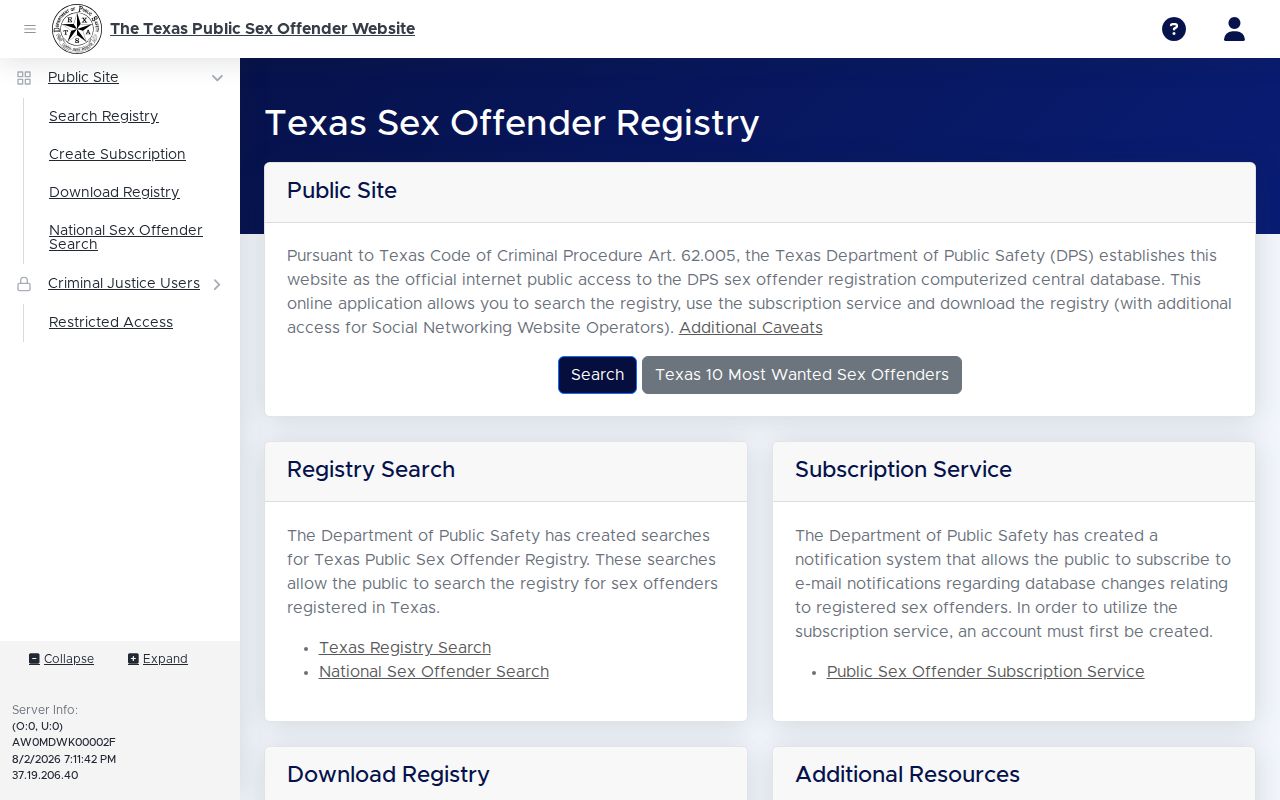
The registry is a narrow corroboration route for an active Chapter 62 duty, not a general released-inmate photo source.
Expunction Notice at Concho Release
Texas Code of Criminal Procedure Article 55A.451 creates a distinctive release-stage requirement. After release or discharge following arrest, the responsible official must provide a written explanation of expunction rights and a copy of Chapter 55A. This notice does not mean every person qualifies, and expunction differs from nondisclosure.
A valid order can explain why an older image, arrest entry, or release record later becomes unavailable. Do not treat the absence as proof that no event occurred. When correcting a copied image, identify the exact source and provide only the order or proof needed under the applicable process. The Concho County release-record guide explains how the arrest, receiving-jail, and court trail can be checked without relying on an image.
Why a Concho Photo Proves No Release
An image answers a narrow question: whether a photograph was associated with a custody or identification record. It does not show the book-out time, release authority, bond, destination, transfer agency, or current legal status. A photo can remain online after release, disappear while custody continues, or be reused in a later article. A namesake or mislabeled copy raises an added risk of mistaken identity.
Pair a receiving-jail photo with that jail's booking number and book-out entry. Pair a TDCJ departmental image with the TDCJ number, current status, and actual release or discharge documentation. For BOP, compare the image or identifying record with the locator's release field and heed the agency's warning that dates can be recalculated. For Eden detainees in USMS or ICE custody, use the responsible federal route.
A court disposition can explain dismissal, sentence, probation, or another legal outcome, but it does not prove the moment the door opened. Concho County's combined clerk places digitally available records online and updates them nightly. Use that durable trail to corroborate the arrest and case, then obtain the physical release record from the custodian.
When publishing, requesting, or correcting an image, keep the description precise. Call it a Concho Sheriff identification photo, a receiving-jail booking photo, a TDCJ departmental photograph, or a federal custodian image as the source requires. Avoid labels that imply guilt, current custody, or community release beyond what the official record states.